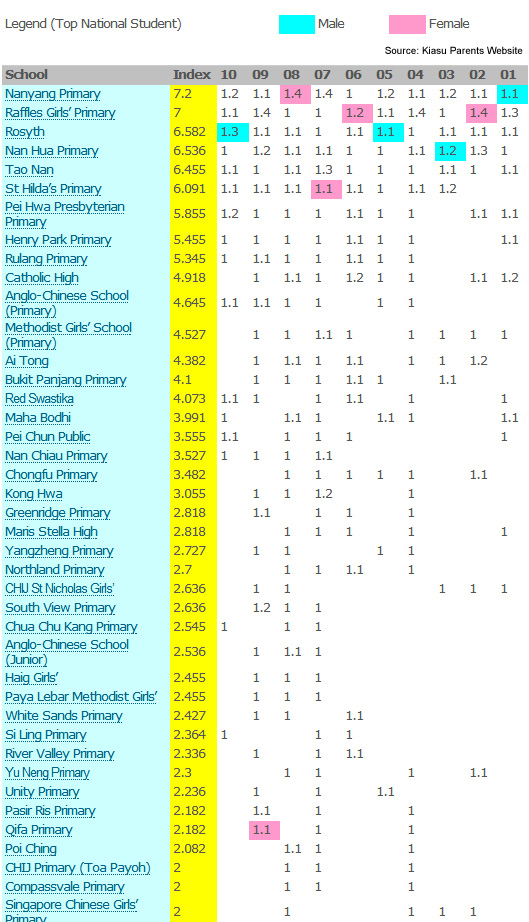
Please visit Kiasu Parents website at http://www.kiasuparents.com/kiasu/content/singapore-primary-schools-ranked-academic-excellence for the complete article and its methodology.
Jan 27
SINGAPORE : The recent government cooling measures in Singapore's property market will bring down sales volume, but not to the extent of causing a significant fall in prices.
According to a report by DTZ Research, sales volume is expected to fall as short-term speculators will be weeded out by the hefty seller's stamp duty of up to 16 per cent within the first year of purchase.
However, the property consultancy said not all investors will withdraw from the market.
Some may find the 4 per cent stamp duty by the fourth year of sale to be surmountable and shift their focus to buying uncompleted units with completion dates three to four years later.
DTZ's Executive Director for Residential, Margaret Thean said landed homes, small apartments and high-end apartments will be less affected by the measures. That's because small units with their low price quantum will continue to attract investors with spare cash or singles wanting their own units.
Thean added that the 4-year seller's stamp duty will have little impact on landed homes as most purchase them for long-term owner-occupation.
Meanwhile, high-end apartments will likely continue to see foreign interest.
DTZ added that prices in 2011 are expected to be largely stable with a decline of not more than 5 per cent.
This is underpinned by economic growth, low interest rates, strong holding power of developers, the appreciation of the Singapore dollar and inflow of foreign purchasers due to the property market clampdown in mainland China and Hong Kong.
The property consultancy does not rule out the possibility of more government measures should demand remain at a high level after a period of cooling-off.
The report also noted other challenges in the form of a spike in the number of completed units in a few years' time as the government is putting out a record high amount of units through the public housing and government land sales programmes.
There is also uncertainty over the strength of recovery of the major western economies.
If they recover well, interest rates will move up and reduce the affordability of mortgage payments.
On the other hand, if they continue to languish, this will have an effect on the Singapore economy and optimism in the property market eventually.
With the residential market facing numerous challenges, DTZ said investors are likely to take the extra effort to identify opportunities in other property sectors and alternative investment products.
For more information, go to MarketWatch www.marketwatch.com
1. Sellers SSD increased from 3 to 4 years on sliding scale at 16% of selling price 12%, 8%, and 4%.
2. LTV lowered from 70 to 60% for 2nd and subsequent loans
3. 50% LTV for non individual buyers (exclude developers buying en bloc for redevelopment), e.g. corporations, trusts and collective investment schemes.
Full information can be found at: http://www.mas.gov.sg/news_room/press_releases/2011/Measures_To_Maintain_A_Stable_And_Sustainable_Property_Market.html
Developers' outlook for the property sector turned rosier in the fourth quarter last year, with a larger proportion of them predicting higher prices for new residential launches.
Preliminary findings from the Real Estate Sentiment Index (RESI) point to improved sentiment from the third quarter, when the industry was still coming to terms with the impact of property market cooling measures introduced on Aug 30.
Based on survey responses so far, the Current Sentiment Index stood at 5.6 in Q4, up from 4.8 in Q3. For this category, respondents rate overall Singapore real estate market conditions now compared with six months ago.
The Future Sentiment Index - where respondents rate overall property market conditions over the next six months - rose to 5.7 in Q4 from 4.8 in Q3.
While the index readings rose in Q4, they did not surpass the levels seen in Q1 and Q2.
Developers were also asked for their take on the primary residential market, and a majority of the respondents thought more launches and moderate price increases were possible.
In Q4, 60 per cent of respondents believed that unit prices would be moderately higher. In Q3, just 12 per cent thought so.
Spottiswoode Residences, Waterview and Robinson Suites were some which reported strong sales.
Some industry watchers also reckoned that the sector's confidence grew as the impact of the tightening measures became clearer.
A Hong Leong spokesman told BT: 'While we took a cautious outlook immediately following the August 2010 cooling measures, buyer demand continued to remain strong for the group's various projects.' Low interest rates and liquidity in the market contributed to the demand, he said.
In the ongoing Q4 RESI survey, 69 per cent of respondents identified demand-side measures from the government as a potential risk to market sentiment.
Although this proportion is less than Q3's 83 per cent, it is still big enough to make state intervention the second most feared risk.
A possible slowdown in the global economy was the industry's top worry - 70 per cent of respondents said in Q4 that this was a potential risk. This is markedly higher than the 56 per cent a quarter ago.
(This is only an excerpt, for the full article please subscribe at http://businesstimes.com.sg)
 |
| Top Scorers for 2010 PSLE and their schools |
The property boom has still not lifted luxury home prices back to their 2007 levels, although units in up market projects are attracting buyers.
It is far from a bargain-basement situation but developers are having to keep their expectations in check, and having to offer attractive prices.
Take Bukit Sembawang's Paterson Suites, which was completed in the third quarter. There were 41 new units sold at a median price of $2,661 per sq ft (psf) last month.
In July a 2,164 sq ft flat went for $7 million - or $3,232 psf.
Yet in July 2007, five units were sold at a median price of $3,369 psf.
The Straits Times understands that 38 of the 41 units were sold to a handful of private investors, mostly foreigners. Each bought several units and received a slight discount.
Three units of Hasetrale Holdings' 8 Napier in Napier Road fetched a median price of $3,348 psf last month. In 2007, some flats went at close to $4,000 psf.
In 2007, Macquarie Global Property Advisors paid $136 million for 19 units at 8 Napier at an average price of $3,550 psf.
Experts said luxury home prices are about 5 per cent shy of their 2007 peak.
Colliers International's director of research and advisory, Ms Tay Huey Ying, said that if prices continue to strengthen, even at a moderate pace, developers will be encouraged to gradually off load more units.
'But this will probably not be on a massive scale because developers are conscious of the strength of the high-end market and are likely to space out their launches evenly and in small volumes,' she added.
Some investors have also opted to buy landed homes instead, as the limited supply of such property means the sector is more resilient to volatility.
Experts added that while it is still early days, there could be increasing pressure on developers to lower prices should the high-end segment continue to languish below its peak - both in terms of price and volume.
Jones Lang LaSalle's head of research for South-east Asia, Dr Chua Yang Liang, said smaller developers with reduced holding power and completed projects on hand would be most affected.
Larger developers could always lease out unsold units, he added.
Urban Redevelopment Authority data for private home sales last month showed that 213 homes in the core city centre region were sold, out of 338 launched - the highest number launched for the segment since March.
This brought total home sales in the city centre this year to 3,741 out of 3,867 units launched as of the end of last month.
These numbers are in line with last year's 3,825 units for the entire year but short of 2007's 5,454 units sold.
Dec 15
SINGAPORE: Private home sales in November rebounded about 80 percent on-month to hit 1,909 units - the second highest in 11 months.
That brings the total number of homes sold so far this year, to 15,025, surpassing the 2007 sales record of 14,811 units.
The surge in November sales comes just three months after the government introduced its latest round of measures to cool the property market.
Lakefront Residences in Jurong was the most popular property selling over 437 units at $1,075 per square foot last month.
Coming in second was Waterview in Tampines, which sold 376 units at $903 per square foot, while Spottiswoode Residences followed with 258 units sold at $1,853 per square foot.
This buying fever in November caught many analysts by surprise.
Tay Huey Ying, Director (Research and Advisory), Colliers International, said: "It just goes to show or prove that a lot of investors are still viewing property as a safe place to park their wealth in spite of the high exposure to policy risks.
And I think another driving factor for November's high sales volume could also be foreign purchases, diverted from the HDB resale market, as well as from Hong Kong and China, in light of their recent property curbs.
With high sales volume, with feverish buying fever, there is bound to be some upward pressure on prices although the ramped up government land sales programme could put a check on the rate of price growth.
If what is driving the November sales happens to be foreign purchases, who may not be too bothered about potential launches, potential supply, then I think it does warrant certain further measures to cool the buying fever."
Industry watchers say the government may end up introducing another harsher set of cooling measures, such as a tax on profits from property sales in the next few months.
Colin Tan, Head (Research and Consultancy), Chesterton Suntec International, said: "What's going to happen if the buying doesn't stop and while we may not feel the impact now, but the consequences may come maybe a year or two later and it can be pretty adverse.
We'll have a lot of units up for rental, then the rentals could collapse especially when there's a lot vested buying.
The worse is of course when rentals come down, and holding cost go up as well, so that will reduce the yield and when yield is miserable, some investors may opt to sell or are forced to sell and that may start a domino effect."
Analysts say the latest figures also show that properties with strong branding and good locations remain the most attractive.
Although the November statistics came as a surprise, many believe the number for December will come back down as developers launch fewer properties over Christmas and New Year.
For the month of December, property watchers expect between 800 and 1,300 units to be sold. - CNA/wk/ch
By Aaron Low
The flood of hot money unleashed by the United States' latest round of monetary easing runs the risk of inflating a Singapore property bubble and increases the chances of further property dampening measures, analysts warned yesterday.
Regional markets - already awash with liquidity from advanced economies seeking better returns in Asia - are expected to be on the receiving end of a large slice of the US$600 billion (S$770 billion) injected by the US Federal Reserve last week.
A Citigroup report noted that loan growth had already been rising and the stock market had seen a flurry of activity, with trading volumes higher and a surge of new listings, even before the latest round of easing was announced.
And Dr Chua Hak Bin, economist at Bank of America-Merrill Lynch, is among a growing number of experts concerned that the low interest rate environment is combining with the flow of liquidity to form 'the right conditions for a bubble to form'.
'It's too early to say if there is indeed a bubble, but the conditions are right,' he said.
Analysts are highlighting property as the asset area most likely to be impacted by these large flows, with the market boosted in two ways.
The more direct route is via foreign funds buying into property directly, pushing prices up.
The other is by flows pushing down interest rates and allowing people to borrow more to buy property.
'Property is probably the most interest-rate-sensitive sector there is and Asians are fanatical about property,' said DBS economist David Carbon.
In August, the Government announced a series of measures to curb property speculation, but Prime Minister Lee Hsien Loong said last week that the Government was still carefully watching the market.
Citigroup economist Kit Wei Zheng said that concern over how much households are borrowing to finance their homes and 'political pressures ahead of general election' could lead to more cooling measures.
'Amid flush liquidity and low interest rates, further administrative tightening measures on property are likely if transaction volumes or prices re-accelerate,' he said.
Dr Chua Yang Liang, head of research at real estate firm Jones Lang LaSalle in Singapore, said such curbs would most likely kick in only if the mass market segment overheats.
He noted that the August measures were primarily aimed at the Housing Board market and mass market condominiums, whereas liquidity from the latest round of quantitative easing - or QE2 as it is termed - is likely to focus more on high-end private market properties.
'A key indicator is how fast prices in the mass market segment will rise. A sustainable rate is 1 to 2 per cent a quarter,' he said.
If the housing market does look in danger of overheating, the Government has a range of weapons to call on, he said.
They include increasing the cash down payment needed to buy property, higher stamp duty, and a more drastic capital gains tax.
By Esther Teo
Good-class bungalow owners are cashing in on rocketing property prices.
A CB Richard Ellis (CBRE) analysis of Urban Redevelopment Authority (URA) Realis caveats shows that good-class bungalows are netting bumper profits for owners who have seen average per sq ft (psf) prices rise almost 30 per cent over the past year.
Several have taken to buying and selling their good-class bungalows within a period of less than two years.
At least seven good-class bungalows bought since May last year have been sold within 18 months of purchase, with four sold within a year, with a profit of as much as 85 per cent over the purchase price.
This massive gain was seen by a 40,677 sq ft good-class bungalow property on Ridout Road near the Holland area, translating to a $17 million gain within a four-month span.
At least one home, on Nassim Road, has even been sold five times within the past six years - soaring from $9.8 million in 2005 to $43.5 million this year.
It sold at $1,800 psf in April this year - almost 4.5 times the $405 psf it was sold for in February 2005. The 24,186 sq ft property had changed hands at $620 psf in August 2006, $760 psf in December the same year, followed by $1,000 psf in June 2007.
Experts said that good-class bungalows have turned out to be one of this year's star investment propositions.
URA data shows that non-landed home prices inched up 1.6 per cent in the third quarter, while prices of detached homes rose 8.4 per cent over the same period.
CBRE said that while the 109 good-class bungalow sales last year had been transacted at $831 psf on average, the 86 transactions this year to September, which totalled $1.6 billion, were done at an average of $1,055 psf - a 27 per cent surge over the previous year.
This increase is one of the steepest over the last 15 years, said Cushman and Wakefield's senior manager of Asia-Pacific research, Mr Ong Kah Seng.
He noted that the keen buying interest in good-class bungalows was being driven by limited supply, making it the safest buy for a home buyer not limited by affordability.
'(Even with) developers' concerted efforts to brand condominiums with innovative concepts, the product is fairly homogeneous...On the other hand, buyers of good-class bungalows, in addition to being proud owners of the land, will be able to highly customise their homes to be materially different from another,' he said.
Mr Douglas Wong, CBRE director of luxury homes, said that the approximately 2,400 good-class bungalows, which can be found in 39 prime gazetted areas such as Nassim, Dalvey and Tanglin, are owned by only about 1,000 individuals.
These owners are usually ultra-high net worth Singaporeans, who are mostly professionals, businessmen or entrepreneurs, he said.
'Many of the buyers might have purchased their homes with the intention of long-term investment, but when the market moves, they might seize the opportunity to make some profits instead,' he added.
Mr Alexs Chua, managing director of property agency AC MacGyver, a specialist in landed homes, said that about 20 per cent of homes sold last year have been put on the market again, although many owners may just be testing the market.
He expects prices to rise another 10 per cent by March next year.
But CBRE's Mr Wong reports that demand had slowed in the third quarter, when 19 good-class bungalows were sold compared to 36 in the second quarter and 31 in the first quarter.
'This could be attributed partly to cautious sentiments and partly to the widening price gap between good-class bungalow owners' expectations and buyers' offers,' he said.
However, he expects the market to achieve about 100 to 120 transactions amounting to about $1.8 billion this year.
Typically, only Singapore citizens can own a good-class bungalow, but permanent residents may obtain permission to buy small bungalows with land areas of about 15,000 sq ft.
As City Developments (CDL) announced yesterday that about 75 per cent of the 150 units at its freehold Glyndebourne condo have been sold since the preview began on Friday, some other developers are rushing to try to release projects before the year-end holiday season sets in.
UOL Group is expected to preview the freehold Spottiswoode Residences condo next week, and the price is expected to be about $2,000 per square feet (psf). About 90 per cent of the 351 units comprise one-bedroom, one-bedroom-plus-study and two-bedroom apartments.
The project, a 36-storey tower, is next to Spottiswoode Park, a green lung in the area, and close to Tanjong Pagar, which is slated to be transformed into a new bustling waterfront district after the container terminals in the vicinity eventually move out.
The Tanjong Pagar Railway Station site is also expected to be redeveloped after Keretapi Tanah Melayu vacates the site under a historic land-swap deal between Singapore and Malaysia announced in September.
Over at Robinson Road, agents are said to be gathering interest for the freehold Robinson Suites at prices ranging from $2,300 psf to $3,300 psf. The 42-storey project, to be developed on the VTB Building site, comprises 167 apartments and three ground-floor shop units. All the apartments are either one-bedroom-plus-study units or two-bedders. Unit sizes start at 484 sq ft.
The developer - a consortium whose shareholders include Cheong Sim Lam (whose family developed International Plaza), Fission Holdings, Tan Koo Chuan and Saw Pik Kee - is pitching the project as the 'first-ever freehold apartments along Robinson Road'.
CapitaLand, meanwhile, is getting ready to release the first phase of its 1,715-unit condo on the 99-year-leasehold Farrer Court site. The 36-storey Zaha Hadid-designed project will feature one to four-bedroom apartments, penthouses and six pairs of strata semi-detached houses.
In the mass-market segment, Sim Lian is said to be gunning to release Waterview, a 99-year-leasehold condo comprising 696 units at Tampines Ave 1/10 facing Bedok Reservoir, as soon as it gets all the necessary approvals from the authorities.
The project will comprise two, three and four-bedroom apartments and penthouses. The average price is expected to be in the $820-920 psf range.
Meanwhile, CDL said yesterday it sold 112 units at its 150-unit Glyndebourne condo on Dunearn Road between Friday and Sunday.
'All one-bedroom-plus-study, two-bedroom and three-bedroom-plus-study units have been snapped up. A wide spectrum of other unit types was also sold, including 10 out of the 23 penthouses,' CDL said in a statement yesterday.
Seventy per cent of the buyers are Singaporeans, with permanent residents and foreigners from Malaysia, the United States, Indonesia, China, India, Myanmar, Korea, Thailand, Taiwan and Brunei making up the remaining 30 per cent.
CDL began previewing the project on Oct 29 on behalf of its London-listed hotel unit Millennium & Copthorne Hotels, which owns the freehold site on which the condo will be developed.
The Copthorne Orchid Hotel Singapore on the site will be closed at the end of March 2011 to make way for the redevelopment of the site into Glyndebourne.
CDL said the 112 units sold were at prices ranging from $1,900 to $2,350 psf, or at an average price of about $2,100 psf.
The worst- kept secret in the property market is out in the open. Not only are developers less upbeat about the future but a third of them actually expect prices of new homes to decline. And market performance for the suburban residential sector may be the worst hit.
This dose of pessimism was reflected in the latest readings of Real Estate Sentiment Index (RESI) put out by the developers body and NUS.
In the wake of the Aug 30 cooling measures, some 34 per cent of developers polled for Q3 expect prices for new residential launches to decline, albeit by less than 10 per cent, over the next six months. None of the developers surveyed in Q1 and Q2 had predicted price drops.
Just 44 per cent expect more new residential units to be launched over the next half year, down from 68 per cent in the previous quarter.
The sentiment indices slipped below the psychologically significant mark of 5 in Q3, indicating respondents were less upbeat in the quarter and expect more uncertain market conditions over the next six months.
The consensus as indicated by net balances is generally weaker.
Polled on how the suburban residential sector would perform, the net balance in Q3 was -43 per cent. This means that most expect the sector to perform worse over the next six months. In Q2, this net balance was +27 per cent, hinting at better future performance.
'The strong historical price growth in the sector is not likely to be sustained moving forward. Downward adjustment to the price growth, if it occurs in the next few months, will ease some pressure on the affordability level of mass-market residential properties in suburban areas,' said Associate Professor Sing Tien Foo of NUS.
The net balance for the future market performance of the prime residential sector, while still in positive territory, has also been declining significantly, from +54 per cent in Q1 to +32 per cent in Q2 and +3 per cent in Q3.
About 70 per cent of the developer respondents in the latest survey were concerned that the government could intervene to dampen the property market further.
They also cited other factors that could hurt sentiment over the next six months. The concerns included a slowdown in the global economy (cited by 60 per cent), an increase in the supply of development land (53 per cent), too many new property launches (49 per cent), rising interest rates (47 per cent) and tightening financing/liquidity in the debt market (40 per cent).
Eighty-four per cent of all survey respondents consider it likely and very likely that there will be a further increase in the supply of development land over the next six months. An even higher proportion, 90 per cent, of respondents expect the government to further boost the supply of Build-to-Order and Design, Build and Sell Scheme public housing flats as well as executive condo (EC) units.
Recent government steps to cool the market are expected to have most impact on the HDB resale and mass private housing market segments. About 76 and 64 per cent respectively of survey respondents rated their impact on these two market segments over the next six months as significant. Conversely, the measures are expected to have the least impact on the high-end/luxury segment with 64 per cent predicting minimal impact. For the mid-end private housing segment, 79 per cent foresee only moderate impact.
Real Estate Developers' Association of Singapore and NUS' Department of Real Estate polled slightly over 70 respondents for their latest Q3 survey, similar to the size for the Q1 and Q2 surveys.
The Current Sentiment Index, where respondents are asked to rate overall Singapore real estate market conditions now compared with six months ago, fell from 5.8 in Q2 to 4.8 in Q3.
The Future Sentiment Index, where respondents rate overall property market conditions over the next six months, also slipped from 5.9 in Q2 to 4.8 in Q3. As a result, the Composite Sentiment Index (the average of the two indices), also declined to 4.8. The index ranges from 0 to 10 with a score below 5 indicating deteriorating market conditions.
Redas CEO Steven Choo said: 'The RESI was able to track closely the immediate impact the cooling measures has on sentiments in the property sector.'
Agreeing, Knight Frank chairman Tan Tiong Cheng said: 'The findings are not surprising. Just look at the amount of land government has been releasing and the supply of new HDB flats and ECs they're planning, plus the demand-side measures. People have put on their thinking caps to figure out how they'll be affected, whether they are HDB upgraders, buying a second/investment property, or even downgrading.
'The latest survey results are a clear signal to government that the measures are having an impact,' he added.
Separately, the NUS' Institute of Real Estate Studies yesterday released its monthly Singapore Residential Price Index tracking prices of completed non-landed private homes. The overall index rose one per cent month on month in September, slightly slower than the 1.1 per cent increase in August.
NUS' sub-index for Central region, which covers a basket of properties in districts 1-4 and 9-11, increased 0.6 per cent in September, the same pace as in August. The sub-index for Non-Central region appreciated 1.4 per cent in September, slightly slower than the 1.6 per cent gain posted in August.
---------------------------------------------------------------
TODAY: Monetary policy tightened
by Millet Enriquez | Oct 15
MAS signals its intent to combat inflation, even as economic growth slows
SINGAPORE - Taking global markets by surprise, the Monetary Authority of Singapore (MAS) tightened its monetary policy yesterday - signaling its intent to combat inflation even as the Republic's economic growth slows.
---------------------------------------------------------------
This is an excerpt. To read the full article, please visit http://todayonline.com
Oct 14
Despite Q3 contraction, Singapore still on track to meet 2010 forecast: MTI
SINGAPORE - The Ministry of Trade and Industry (MTI) announced this morning that the Singapore economy remains on track to achieve the overall growth forecast of 13 to 15 per cent for the whole of 2010.
Advance estimates showed that the economy expanded by 10.3 per cent in the third quarter of 2010 compared to the same period a year ago. However, on a seasonally-adjusted quarter-on-quarter annualised basis, the economy contracted by 19.8 per cent, a reversal from the growth of 27.3 per cent in the previous quarter.
The median forecast of 19 economists surveyed by Bloomberg News was for a 15.7-per-cent contraction.
"The decline in growth momentum was an expected correction from the exceptional growth in the first half of the year," noted the MTI in its press release.
Asian nations from Thailand to Japan have taken steps in the past month to cool the appreciation in their currencies, which is threatening exports at a time when global growth is slowing. Prime Minister Lee Hsien Loong has said Singapore's economy may "moderate" in the coming months after a record first-half expansion, citing risks from the Europe and the United States.
"Singapore is typically a bellwether for the region's export outlook and it is the first to show cracks as global growth slows," economist Alvin Liew of Standard Chartered said before the report. Threats to Asian growth include "the fading impact of stimulus packages, stubbornly high unemployment rates and austerity measures that are likely to crimp consumption in the West," he added.
On a seasonally adjusted quarter-on-quarter annualised basis, the manufacturing sector contracted by 57 per cent in the third quarter, after expanding by 67 per cent in the preceding quarter. This decline is largely attributable to the biomedical manufacturing cluster, the MTI said.
The construction sector also contracted on a seasonally adjusted quarter-on-quarter annualised basis, by 12 per cent, compared to an expansion of 29 per cent in the preceding quarter. This was mainly due to the completion of key commercial and industrial building projects earlier in the year.
The services producing industries registered a modest sequential growth of 1.6 per cent, following a 13 per cent expansion in the previous quarter. Growth in trade-related services sectors, such as wholesale trade and transport and storage moderated from the high growth seen in the first half of the year.
Growth in the rest of the year will be underpinned by a number of industry-specific factors, noted the Trade Ministry. In particular, continued growth in global demand for electronic products will lend some support to the electronics and precision engineering clusters.
Increasing visitor arrivals driven by a resurgent Asian market and new tourism product offerings such as the Integrated Resorts will continue to bolster the tourism-related sectors, the Ministry added.
MTI will release the preliminary GDP estimates for the third quarter of 2010, next month in the Economic Survey of Singapore.
